Charlie ended his recent article with the words Jesus spoke to the man with the withered hand: “Stretch out your hand.”
That is worth sitting with. Then it is worth getting up with.
The man was being asked to attempt the very thing his affliction made difficult. Christ supplied the healing. The man still had to respond.
There is something there for those of us who have spent considerable time praying about the condition of our country, our Church, and our communities—and wondering what comes next.
Some of what comes next requires a response from us. This is generally where participation begins to thin.
What Will We Build?
One of Charlie’s central points is that setting things right temporally leaves us with a responsibility. Better conditions give us room to rebuild. We have to decide what will occupy that room.
Laws can protect religious freedom. Practicing the faith falls to us. Public officials can remove obstacles to family life. Forming families, supporting parents, and helping children grow into faithful adults require people willing to do those things.
The same holds true in our neighborhoods and parishes. Someone has to welcome the newcomer, teach the skill, visit the isolated person, organize the work, and come back when the initial enthusiasm has worn off.
We are among those someones.
I checked. There is no separate committee coming.
That is where Go Forth belongs.
Many in CORAC are already doing this—helping neighbors, teaching skills, organizing practical efforts, and quietly following through. Their work gives the rest of us something to learn from and join.
This invitation is especially for those of us still on the fence, discussing the possibilities. The view from there is familiar by now. Someone could probably use the lumber.
We Have Been Practicing for Something
The early Field Notes began with ordinary things: learning a name, making a specific offer, asking for help, bringing someone alongside us, and returning.
Those exercises help us become people who notice, listen, keep our word, and cooperate. The Rally Trail builds on them by helping us gather people around useful work.
We have been practicing for responsibility.
As relationships strengthen and experience grows, we should become capable of carrying more together. One visit may reveal several homebound neighbors who need dependable contact. One repair may bring together people willing to help other households. One training session may become a regular opportunity to learn, practice, and teach.
That growth requires somebody to recognize the possibility and take responsibility for moving it forward.
We cannot keep returning to the starting line because we have become comfortable there. At some point, the stretching exercises become a fairly elaborate way of avoiding the walk.
The Next Step May Be Inconvenient
Most of us do not need convincing that something should be done.
We can discuss the need at considerable length. We may even know precisely what other people ought to do about it.
Our own part becomes harder to identify around the time it interferes with Wednesday.
Digital channels make this especially easy. We can read, react, encourage, share a useful link, and emerge forty-five minutes later feeling pleasantly involved. Meanwhile, the neighbor we were discussing has spent the same forty-five minutes waiting for somebody to call.
The conversation can help us organize a response. Eventually, somebody has to leave it long enough to carry one out.
Accepting responsibility means allowing a real need to make a legitimate claim on our time and attention. It may mean making an awkward call, asking others to help, learning something unfamiliar, or beginning without assurance that everything will go smoothly.
The Catechism puts it plainly: “By prayer we can discern ‘what is the will of God’ and obtain the endurance to do it” (CCC 2826).
We need grace to recognize our duty, courage to accept it, and humility to learn when our first attempt goes sideways. Sometimes the next right step is already clear enough. We are waiting to feel more comfortable taking it.
Wednesday remains stubbornly unavailable.
According to Our Station
Charlie’s reminder that we must make our stand according to our station in life matters here.
A parent caring for young children, a full-time caregiver, a person living with illness, and a retiree with practical skills have different responsibilities and capacities. Some people already carry heavy burdens quietly. We should learn what those burdens are and help shoulder them.
Each of us can still examine our circumstances honestly.
What has God already entrusted to me? What can I reasonably contribute? Where could joining with others make us more useful?
Someone who can no longer do repairs may be able to arrange them. Someone with limited time may accept one dependable part of a larger undertaking. Someone who needs help may know another person whose need has gone unnoticed.
An honest commitment makes room for real limits. It also gives others something they can count on.
And if every undertaking falls to the same three dependable people, the rest of us should probably stop admiring them long enough to take something off their hands.
Stretch Out Your Hand
Before we sit down to Thanksgiving dinner, let’s each follow through on one useful commitment that helps someone beyond our own household.
Make the call. Accept a responsibility. Invite another person to help carry the work. Then come back and tell us what happened, including what proved difficult.
That gives the rest of us something to support, learn from, and build upon. A report that the job required two trips to the hardware store may be more useful than another stirring declaration of readiness.
We can spend a great deal of time discussing the renewal we hope to see. Meanwhile, a portion of it may be waiting on a fairly ordinary decision from us.
God knows the condition of our hands.
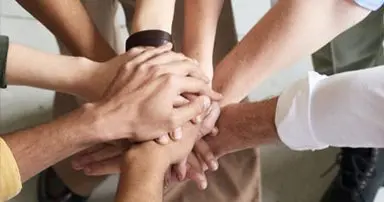
He is still asking us to stretch them out.